

Smart Cable Pulling Systems:
What Electrical Contractors Need to Know
Manual cable pulling on large commercial projects carries hidden costs that rarely appear in a tender. Labour overruns, programme risk, cable damage, and manual handling exposure all erode margin — often before anyone notices. TFP’s fully automated smart cable pulling system changes the calculation entirely.
The True Cost of Manual Cable Pulling
Most electrical contractors price cable ladder pulls based on labour day rates and drum quantities. What rarely gets priced in is the full exposure that manual pulling creates on large projects — and it is significant.
A long HV or LV cable ladder run typically requires 5–6 operatives standing at intervals along the route, maintaining tension and feeding cable across the run. On a 2,000m installation, that team could spend 4–5 days completing the pull — assuming nothing goes wrong.
The risks that can push that figure higher are well known to anyone who has managed a large M&E programme: cable jackets damaged mid-pull from friction or snagging, operatives fatiguing on the back half of a long run causing uncontrolled force spikes, and teams falling behind a locked programme window.
It is not just the labour on the day. It is the re-work cost when a cable jacket gets damaged, the liquidated damages exposure when the pull delays the programme, and the RIDDOR risk from repetitive manual handling on heavy drum pulls.
How the Automated Smart Cable Pulling System Works
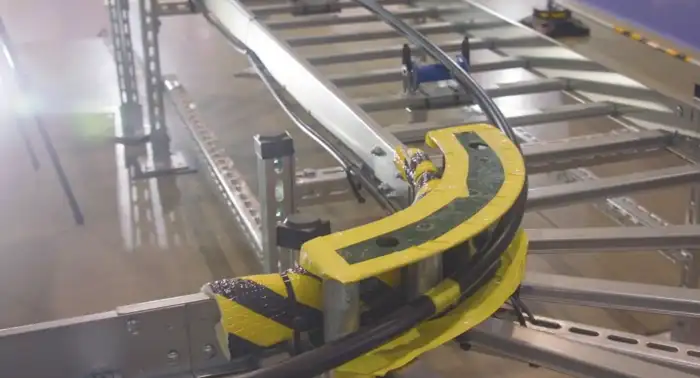
TFP operates a fully automated smart cable pulling system — the only company in the UK and Europe with exclusive distribution rights to this technology. The system replaces the manual operatives stationed along a cable ladder run with a controlled, motorised pulling mechanism that manages tension, speed, and force throughout the entire pull.
Key System Capabilities
The system uses a grooveless Powerball design that maintains consistent, controlled tension throughout the pull — eliminating the force spikes that cause cable jacket damage on manual runs. The speed and tension are managed automatically, meaning performance does not degrade over a long run as operator fatigue sets in.
TFP engineers arrive with the complete system. No separate plant or specialist equipment hire is required. The system is configured on site for the specific cable types and ladder routes, and the pull is managed and monitored by 2–3 TFP operatives — rather than the 5–6 that a manual equivalent would require.
Manual vs Automated: Side by Side
The same 2,000m LV cable installation on cable ladder. Two very different outcomes.
- — 5–6 operatives required on the pull
- — 4–5 days to complete the run
- — High cable jacket damage risk on long runs
- — Significant manual handling exposure
- — Programme at risk if team falls behind
- — Force spikes from fatigue mid-pull
- — Re-work cost if damage occurs
- — 2–3 operatives required
- — 1–2 days to complete the run
- — Controlled tension — grooveless Powerball design
- — Dramatically reduced manual handling exposure
- — Programme milestone protected
- — Consistent speed throughout — no fatigue
- — Zero cable jacket damage on site
Same job. Same cable. Same ladder system. Approximately half the team, half the time — and that is before the re-work risk is factored in.
Programme Protection on Large Projects
Cable installation is frequently on the critical path of the M&E programme. When manual pulling falls behind on a long, heavy cable ladder run, everything else moves with it — and with it, your exposure to liquidated damages.
The automated system operates at up to 25 metres per minute, with up to 40 pullers per inverter running simultaneously. Long cable ladder runs are completed significantly faster, with consistent tension from start to finish — no slowing down mid-run as the team tires on the back half of a long pull.
If you have a large project with significant cable ladder pulls coming up, get TFP into your programme planning before the schedule is locked. A no-obligation site survey and demonstration is available.
Health & Safety: The Risk That Gets Underestimated
Manual cable ladder pulling is one of the most physically demanding tasks in electrical installation — and it regularly gets underestimated in the RAMS. Think about what the task actually involves on a large commercial project:
- Teams of 5–6 operatives pulling heavy cable drums in confined or elevated spaces, often for extended periods.
- Repetitive strain loading on wrists, shoulders, and backs — compounded across a full working day on long runs.
- Force spikes when cables snag — sudden, unpredictable loading events that carry a significant injury risk.
- Fatigue-related incidents in the back half of a long pull, when operative concentration and physical capacity are reduced.
- CDM compliance exposure — manual cable pulling at scale is a real manual handling risk that must be properly assessed and mitigated under CDM regulations.
TFP’s automated system eliminates the physical pulling work entirely. Operatives manage and monitor the system rather than performing the manual task — dramatically reducing manual handling exposure and removing the primary injury risk from the operation.
The automated cable pulling methodology is CDM compliant and produces a significantly better manual handling profile than a conventional pull team — a meaningful advantage when a principal contractor is reviewing your RAMS submission.
Using TFP as a Subcontractor
TFP’s smart cable pulling service is designed to be brought in as a specialist subcontract resource — allowing electrical contractors and civil engineers to win and deliver large projects with significant cable ladder scopes without carrying the full direct labour overhead.
The model is straightforward: you win the contract and hold the client relationship. TFP delivers the cable pull. You retain the margin and the client, and the project moves faster with less risk.
TFP engineers arrive on site fully equipped. The system is configured, the pull is completed, and full BS 7671 certification is provided at handover. The contractor retains complete control of the project and programme.
NICEIC approved · £10M public liability insurance · 12-month guarantee on all cable pulling works · Full BS 7671 certification at handover.
Summary
The smart cable pulling system is not a marginal improvement on manual methods — it is a fundamentally different approach to large cable ladder installations. The reduction in labour, programme time, manual handling risk, and cable damage exposure is substantial on any project of scale.
For electrical contractors pricing large projects, getting TFP into the tender pack early is the most straightforward way to protect margin, protect programme, and de-risk the M&E scope before works begin.
A smart cable pulling system is a fully automated, motorised cable installation system that replaces manual operative teams on large cable ladder runs. It manages cable tension, speed, and pulling force automatically throughout the run — eliminating the labour-intensive manual process and the associated risks of cable damage, force spikes, and programme overruns.
The TFP automated system requires 2–3 operatives to manage and monitor the pull, compared to the 5–6 operatives typically required for an equivalent manual cable ladder pull on a large commercial project. On a 2,000m LV cable installation, this represents a reduction of approximately 60% in pull-day labour.
The system operates at up to 25 metres per minute, with up to 40 pullers per inverter running simultaneously. On long cable ladder runs, this produces completion times approximately 70% faster than manual pulling — typically 1–2 days for runs that would take 4–5 days manually.
Yes. TFP provides full BS 7671 certification at handover for all cable pulling works. The service is NICEIC approved, carries £10M public liability insurance, and all works are covered by a 12-month guarantee.
Yes — this is the primary model TFP operates. Electrical contractors and civil engineers bring TFP in as a specialist subcontractor for the cable pulling scope. You retain the client relationship and project control; TFP delivers the cable pull with full certification. A no-obligation site survey is available for projects at tender stage.
Yes. The automated cable pulling methodology is CDM compliant and produces a significantly better manual handling risk profile than a conventional pull team. This is a meaningful advantage when submitting RAMS to a principal contractor on a large commercial project.
