

Why the Way You Pull Cable
Matters More Than the Cable Itself
Excessive pulling tension during cable installation creates invisible internal damage that passes visual inspection and early testing — and then finds you months later, usually on a project where you can least afford it.
There’s a conversation that happens regularly in the HV cable industry, usually after something has gone wrong. The client says it was a cable defect. The contractor says the cable was fine when it went in. The manufacturer says their product met specification. Everyone points at everyone else.
The answer, when you actually dig into it, is usually none of the above. The cable was fine. The installation was the problem.
I’ve had a version of this conversation more times than I’d like. After twenty years in commercial electrical, I’ve watched installation damage get misattributed, missed entirely, or discovered far too late to do anything cheap about it. What follows is an attempt to explain why — and what a fundamentally different installation approach changes.
The cable was fine. The installation was the problem — and most of the time, nobody in the room knows it yet.Glen Flavell · Director, TFP Electrical Fire & Security
The problem no one sees in the moment
Every power cable has a maximum allowable pulling tension specified by the manufacturer. It’s an engineering limit, derived from the cable’s construction, the materials in its insulation and sheath, the cross-section of its conductors. Exceed it during installation and you create internal stresses that the cable’s outer appearance simply doesn’t show.
The sheath looks intact. The geometry looks right. But inside, conductor strands have stretched, insulation has been distorted, and the interface between components has been compromised in ways that no site inspection picks up.
This damage doesn’t always declare itself immediately. Initial electrical testing can come back clean. The cable goes into service. Six months later, or two years later, a partial discharge develops into a fault. The cable fails. And now you’re trying to work out why.
The answer is the pull. Specifically, a pull that exceeded the manufacturer’s limit at some point along the route, in a way that no one detected at the time because the monitoring wasn’t continuous or the estimation was optimistic. The cable carried the damage for its entire working life and eventually showed it.
Why winching concentrates the risk
Conventional cable pulling with a winch concentrates all the tension at one point: the pulling head. As the cable travels along the route, every metre of conduit friction, every bend, every sheave adds to the load that accumulates at that single point. In a long, complex route with multiple bends, that number can climb fast.
The winch doesn’t know. It doesn’t have awareness of the cable’s rated limit or the point at which internal damage begins. It’s designed to overcome resistance, and it will keep doing that until something stops it.
The operator has a load cell. But a load cell at the winch end gives you the total tension at that point, not the tension at the most stressed section of the run. And if the operator’s focus is on getting the cable through a difficult section, the monitoring can lag behind the risk. This is how invisible damage happens on projects where everyone involved is experienced, conscientious, and trying to do the right thing.
What stored energy means on a real site
There’s another dimension to the winch risk that matters particularly in occupied buildings and live environments: stored energy.
A conventional high-tension pull puts significant stored energy into the cable and the rigging. If a rigging component fails, if the cable catches and releases suddenly, that energy is released. Snap-back incidents involving winch cables are documented across multiple industry sectors. The British Drilling Association, WorkSafe Queensland, and the IMCA have all issued safety alerts following injuries caused by winch-related release events. The forces involved can be severe.
When you reduce the tension in the system from thousands of pounds to tens of pounds, you remove most of that stored energy. This isn’t a marginal improvement. It’s a qualitative change in the risk profile of the entire operation — and it’s not something you can replicate by being more careful with a conventional winch. The physics don’t allow for it.
A different way to think about the problem
The question we kept coming back to was this: why does all the tension have to accumulate at one point?
In a conventional pull, it does, because there’s only one drive point at the head. The friction from every section of the run sums together into that single load. You can reduce it with lubricant, with bigger bending radius, with route redesign — but you can’t escape the fundamental physics while you have a single pull point.
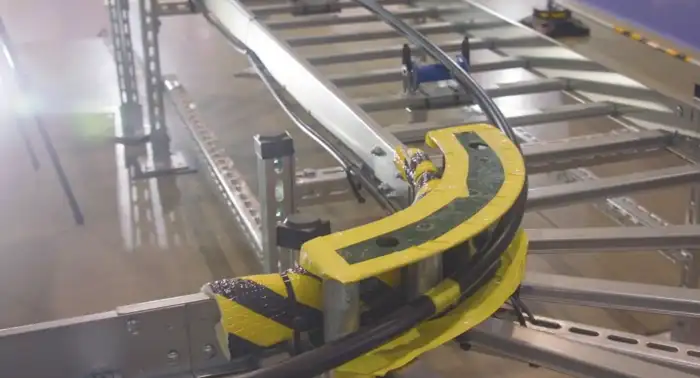
What changes when you have multiple synchronised drive units spaced along the run is that the tension gets reset at each unit. No single span ever sees the full accumulated friction of the entire route. The effective peak tension drops dramatically. The cable operates well within its rated limits throughout the installation.
In practical terms, this means runs that would previously have required intermediate joints to keep the pulling tensions manageable can often be completed in one continuous pull. That removes a jointing operation, removes a programme risk, and removes a future maintenance point. Every intermediate joint you don’t have is a future fault you don’t need to manage.
Traditional methods rely on one device dragging the entire cable, concentrating force and risking the cable’s rated tension. A distributed system uses multiple synchronised units that advance the cable from within the run, keeping tension between units extremely low and evenly controlled throughout.
What this looks like on a project
We’re roughly a third faster on complex routes with this method, compared with conventional approaches. Not because we’re rushing — because we’re not stopping to break the run into sections, and because we’re not dealing with the consequences of installation damage discovered at commissioning.
Real-time tension monitoring throughout the pull also means that variations from the designed route — a bend that’s slightly tighter than specified, debris in a duct, an unexpected section of friction — are caught before they become problems, not after. The static calculation tells you what should happen. The real-time data tells you what is happening.
A cable that goes in right, first time, under continuous monitoring, within the manufacturer’s specified limits, is a cable that will perform for its design life. That’s what the client paid for. That’s what the installation should deliver.
The cable itself is rarely the problem. The method is the variable we can control.
